Georgia: Injured protestors and journalists take case to Europe’s highest human rights court
Content warning: police violence; ill treatment of protestors resulting in serious injury.
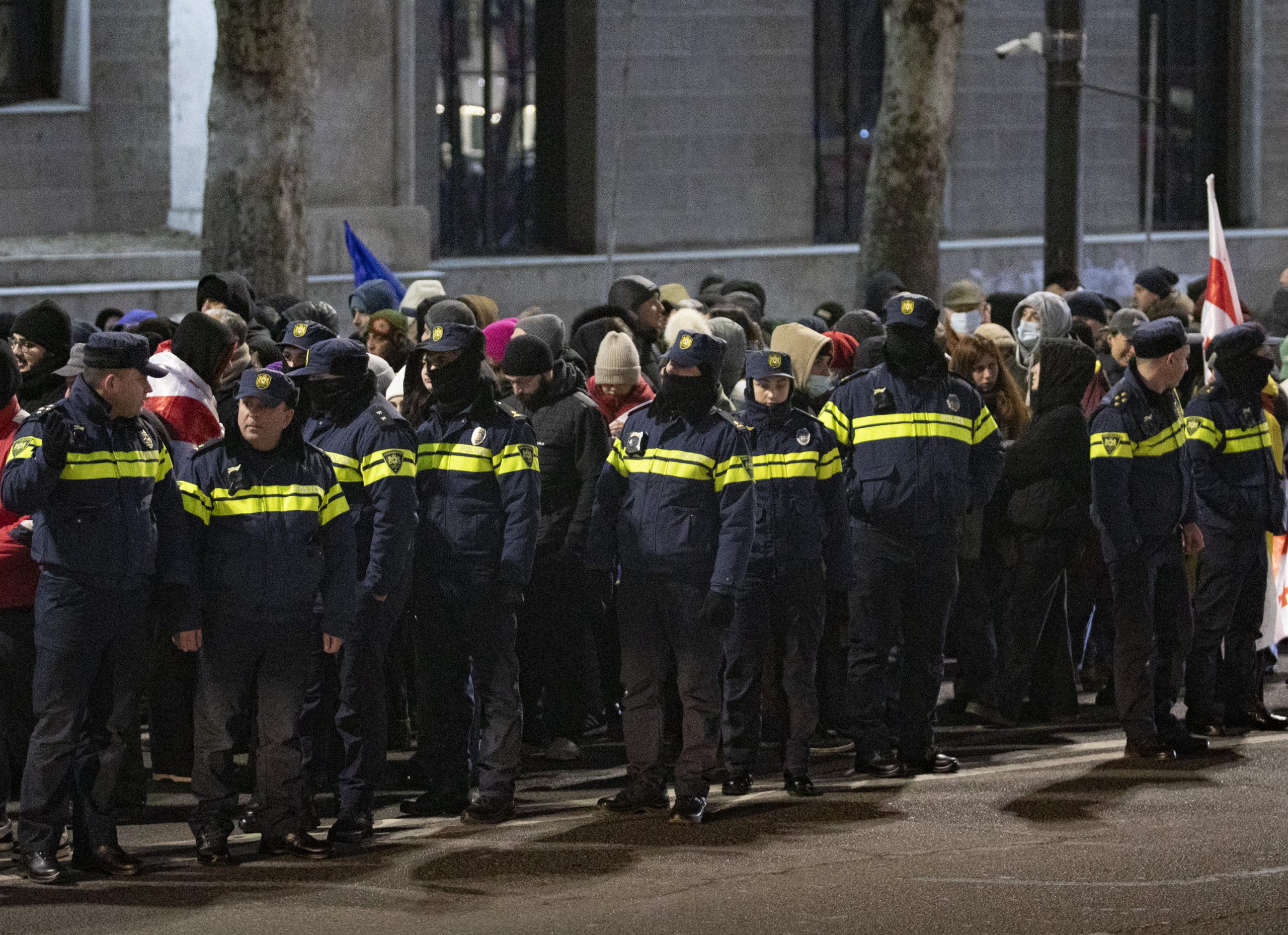
On 26 February 2025, the Grand Chamber of the European Court of Human Rights heard a case with clear implications for Georgia’s democratic opposition, for media freedom in that country, and for the policing of protests across Europe.
On 20 June 2019, Sergei Gavrilov, an outspoken member of the Russian Duma, was invited to sit in the chair reserved for the Speaker of the Georgian Parliament. Gavrilov proceeded to address the assembled audience in Russian, a deeply provocative act given the history between the two nations, and the ongoing occupation of Georgian territory by Russian-backed separatists.
In the hours that followed, an estimated 15,000 protestors gathered outside Parliament to express their anger at the government officials who enabled Gavrilov to take this symbolic action. An impromptu rally ensued – parliamentarians called for electoral reform and the resignation of senior figures in the Georgian government.
Around midnight, police opened fire on the crowd, with tear gas then rubber bullets. No prior warning was given and police fired indiscriminately, in some cases from elevated positions, in contravention of both Georgian and international guidelines on the use of these weapons. Police also used brutal force against protestors and journalists. Victims were punched, kicked and beaten with batons.
The dispersal operation lasted for almost seven hours. Police fired over 800 rounds of rubber bullets. 187 civilians and 38 journalists are recorded as having been hurt as the result of police action. Some lost eyes, or their eyesight. Others suffered fractures to their faces as the result of rubber bullets.
Maia Gomuri was eighteen at the time and attending her first protest. She lost her left eye after being struck by a rubber bullet. She recalls screaming while searching for an ambulance. She underwent four emergency operations and suffered constant pain for months after the protest, due to her life-changing injuries.
Giorgi Diasamidze, an experienced multimedia journalist who has been covering protests in Georgia since 2014, was attacked by a police officer while broadcasting live on Facebook, for the news platform Netgazeti. While suffering the effects of tear gas, he was led into a side street, and then to the courtyard of the Parliament building. Along the way, he was struck multiple times by police officers and repeatedly verbally abused. The phone he had been using to share updates on the dispersal operation was smashed by police.
The case, Tsaava and Others v Georgia, has taken on increased importance given the ongoing protests across the country. Last night, a series of rallies converged again on the Georgian Parliament, on the 90th consecutive night of anti-government demonstrations.
Since 2019, the Georgian authorities have watered down the regulatory framework to permit the parallel use of what are known as ‘less-lethal weapons’ – rubber bullets, tear gas and other ‘active special means’ designed to address violent disorder. This is a violation of international standards. Police action to target dissenting voices and suppress protests has become commonplace in Georgia, and the Georgian authorities have been criticised internationally for the mass detention and ill-treatment of protestors.
The Grand Chamber hearing is scheduled for the day after Soviet Occupation Day, the anniversary of the declaration, in 1921, of a Georgian Soviet Socialist Republic. The Red Army’s invasion of Georgia, which led to the overthrow of the Georgian government and the dissolution of the Democratic Republic of Georgia, is viewed by many as an example of the effects on the Georgian people of Russian expansionism. Large crowds are expected to attend rallies across the country.
The victims hope that the Grand Chamber judgment will set clear guidance on the policing of protests and the use of less-lethal weapons, in Georgia and in all member states of the Council of Europe.
The Grand Chamber hearing
The Georgian Young Lawyers Association (GYLA) and the European Human Rights Advocacy Centre (EHRAC) are representing 22 applicants in this case – 11 protestors and 11 journalists. All sustained injuries as a result of the police dispersal of the protest.
The Court has joined these applications to three other applications by the Georgian NGO, Human Rights Center, concerning four journalists injured at the same protest.
Lawyers from GYLA and EHRAC will argue that:
- the regulation of less-lethal weapons, particularly rubber-bullets, in Georgia is deficient, and the planning and operation of the police dispersal operation on 20-21 June 2019 was inadequate. These systemic issues resulted in the unlawful, unnecessary and disproportionate use of force against the applicants (a violation of Article 3 of the European Convention on Human Rights)
- the police action further violated the protestors’ freedom of peaceful assembly (Article 11) and the journalists’ freedom of expression (Article 10)
- After 5 years, the domestic investigation into the events of 20-21 June 2019 has been shown to be ineffective, leaving the applicants with no effective domestic remedy to redress their complaints (the procedural arm of Article 3 and Article 13)
The need for accountability
The Georgian authorities opened an official criminal investigation into misuse of authority by police officers shortly after the protest and, while hundreds of people were interviewed during this investigation, only three low-level police officers have so far been investigated and charged.
The September 2021 Amnesty Act exempted all involved from criminal liability and punishment for criminal acts related to the events of 20-21 June 2019. The three police officers charged under the domestic investigation were amnestied as a result of this Act.
Referral to the Grand Chamber
On 7 May 2024, in its judgment, the European Court of Human Rights found the State failed to conduct an effective investigation (in violation of procedural Article 3) but “refrained” from coming to a decision on the main issues in this case, on the basis that it believed that the domestic investigation was not ‘irretrievably undermined’ and could still establish the facts.
This was an unprecedented step by the Court, and so GYLA and EHRAC (with the consent of a third NGO Human Rights Center, which is representing four journalists injured in the same protest) requested a referral to the Grand Chamber, arguing that the judgment undermined key aspects of the European Convention on Human Rights. Successful requests are very rare, particularly when made by the applicants, and only occur if there is a serious issue affecting the interpretation of the Convention, or a matter of serious importance for the country concerned.
Fifteen NGOs from around the world that form the International Network of Civil Liberties Organisations (INCLO) have submitted a third-party intervention that sets out the international standards on the use of so-called “less lethal weapons”.
PEN International, PEN Georgia and English PEN have submitted a third-party intervention on the standards protecting journalists at protests and the situation of journalists in Georgia.